Category: Uncategorized

  • ATS Resume Checker — Instant ATS Score and Resume Analysis

    Not sure why your resume keeps getting rejected? An ATS resume
    checker shows you exactly how your resume scores against a job
    description — before a recruiter ever sees it.
    ATS resume checker free tool by MyResumeScan
    ATS resume checker free tool by MyResumeScan

    What Is an ATS Resume Checker?

    An ATS resume checker is a tool that simulates how an Applicant
    Tracking System reads and scores your resume against a specific
    job description.

    When you apply for a job online, your resume goes through an ATS
    before any human sees it. The system parses your document,
    extracts keywords, and scores how well your resume matches the
    job description. Only applications above a certain score get
    reviewed by a recruiter.

    An ATS resume checker replicates that process so you can see
    your score before you submit — and fix what is holding you back.


    Why Your Resume Gets Rejected Before Anyone Reads It

    Most candidates assume resume rejection means a recruiter read
    their resume and decided they were not a fit. In most cases
    that is not what happened.

    Over 90% of large companies use an ATS to filter applications.
    If your resume does not score above the threshold for a specific
    role, it is automatically deprioritized — and the recruiter
    never sees it at all.

    The reasons resumes score poorly are consistent:

    • Missing keywords — the core skills from the job description do not appear in your experience bullets
    • Keywords in the wrong place — listing skills in a skills section only gives 50% credit versus using them in experience context
    • Formatting that breaks parsing — tables, columns, headers, and graphics that look fine to humans but confuse ATS parsing
    • Experience mismatch — applying for a senior role with junior-level language, or missing the years of experience the JD requires
    • No measurable impact — responsibility-only bullets with no outcomes or metrics

    An ATS resume checker identifies exactly which of these problems
    your resume has — for this specific job description, not in
    general.
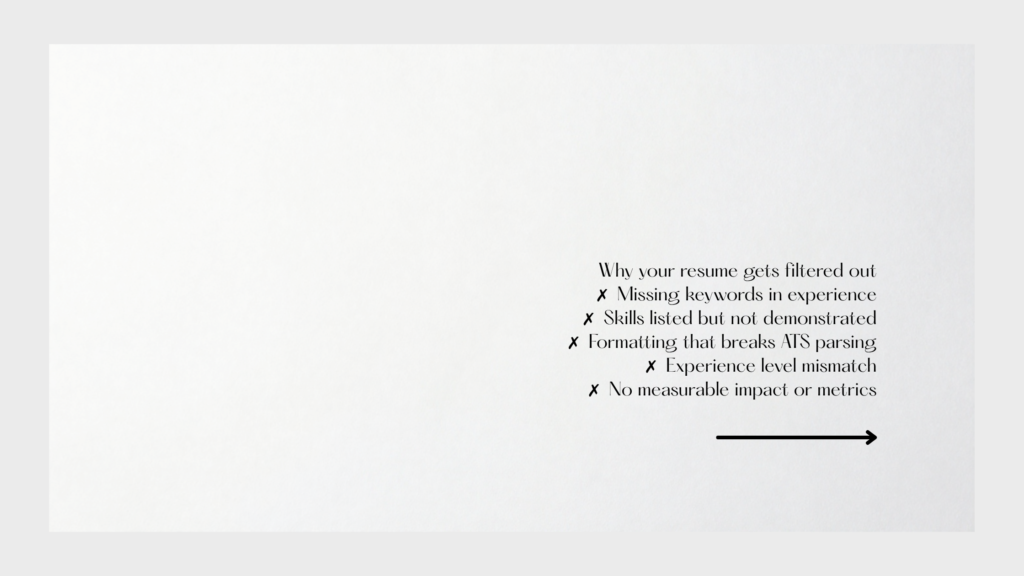
    Why resumes get rejected by ATS systems
    Why resumes get rejected by ATS systems

    What Our ATS Resume Checker Checks

    MyResumeScan evaluates your resume across five categories and produces a score for each:

    Required Skills Match (35%)

    The largest single factor. Compares the core technical skills,
    tools, and competencies listed as required in the job description
    against what appears in your resume — with context. A skill
    listed only in your skills section scores lower than the same
    skill described in an experience bullet.

    Experience and Seniority (25%)

    Checks how many years of relevant experience you have shown,
    whether your job titles align with the seniority level of the
    role, and whether your career progression matches what the
    employer expects.

    Tools, Technologies and Keywords (15%)

    Beyond core skills, this covers specific tools, platforms,
    certifications, and technologies the job description mentions.
    Exact terminology matters — “container orchestration” scores
    lower than “Kubernetes” if the JD specifically says Kubernetes.

    Responsibilities and Impact Alignment (15%)

    Checks whether your experience bullets describe work similar
    to what the role requires, and whether that work includes
    outcomes and metrics rather than just responsibilities.

    ATS Readability (10%)

    Evaluates how cleanly the ATS can parse your resume — section
    headings, formatting, structure, and whether content is
    organized in a way the system can correctly categorize.
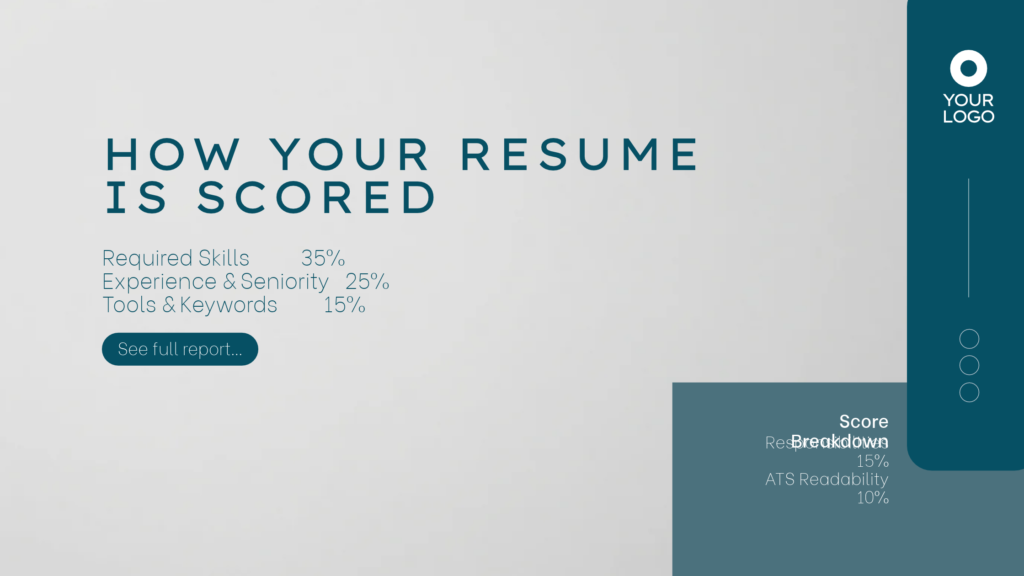
    ATS resume score breakdown across five categories
    ATS resume score breakdown across five categories

    How to Use the ATS Resume Checker

    Using the checker takes less than two minutes:

    • Step 1 — Upload or paste your resume text
    • Step 2 — Paste the job description you are applying for
    • Step 3 — Get your ATS score, subscore breakdown, missing keywords, and specific recommendations

    The results tell you exactly what to fix — not general advice,
    but specific gaps tied to this job description. Fix the gaps,
    re-scan, and submit with confidence.


    What a Good ATS Score Looks Like

    ATS scores are not pass or fail — they exist on a spectrum.
    Here is how to interpret yours:

    • 85–100 — Strong Hire signal. Your resume is tightly aligned with this job description. You are likely to be reviewed.
    • 72–84 — Hire signal. Strong match. Minor gaps may exist but your application is competitive.
    • 58–71 — Lean Hire. Some alignment but meaningful gaps. Worth improving before submitting.
    • 42–57 — No Hire signal. Significant gaps between your resume and the JD. Submitting without changes is unlikely to result in a callback.
    • Below 42 — Strong No Hire. Major mismatch. Either the role is not the right fit or the resume needs substantial work before applying.

    A score below 65 is worth improving before you submit. The
    difference between a 55 and a 75 is often three or four
    targeted edits to your experience bullets — not a full resume
    rewrite.
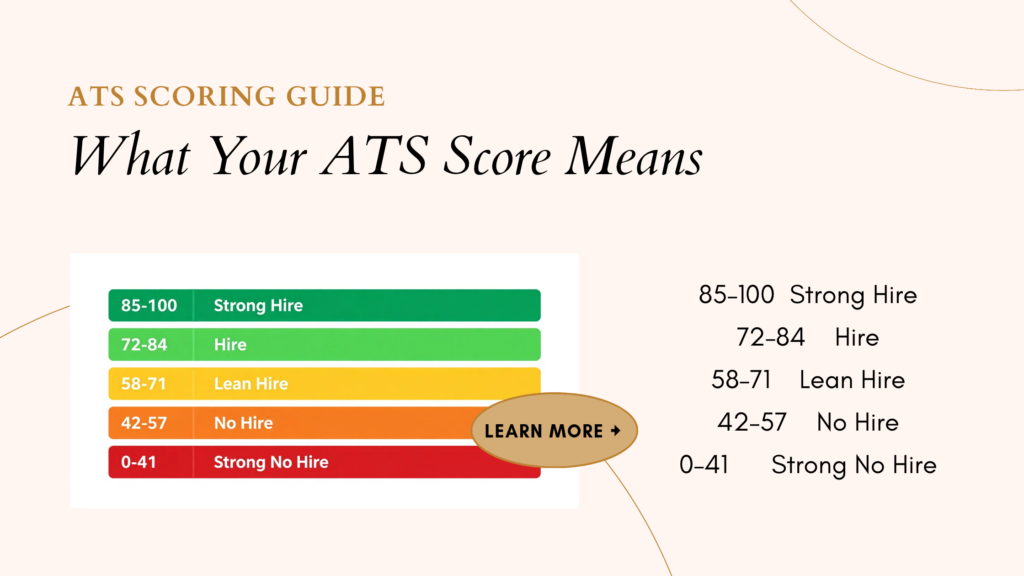
    ATS score range from Strong Hire to Strong No Hire
    ATS score range from Strong Hire to Strong No Hire

    ATS Resume Checker vs Generic Resume Checker

    Most free resume checkers on the internet check your resume
    in isolation — they look for formatting issues, length,
    action verbs, and general readability.

    That is useful but incomplete. An ATS does not score your
    resume in isolation. It scores it against a specific job
    description. A resume that checks every general best-practice
    box can still score 40 against a specific JD if the
    terminology does not match.

    The difference with an ATS resume checker:

    • You provide the job description — the score is specific to that role, not generic
    • Missing keywords are extracted from the actual JD — not a generic list of “good resume words”
    • The hire recommendation reflects fit for this role specifically
    • Fixing the gaps moves your score for this application — not just makes your resume look better in general

    Common Questions About ATS Resume Checkers

    Is the ATS resume checker free?

    Yes. You can scan your resume against any job description
    for free at

    myresumescan.com/ats-resume-checker with no account
    required.

    Does it work for all job types?

    Yes. The checker works for any role that has a job
    description. The analysis is driven by the JD you provide —
    so it works equally well for software engineering, marketing,
    finance, operations, or any other field.

    Will using a checker guarantee I get an interview?

    No tool can guarantee an interview. What the checker does
    is remove a preventable barrier — a low ATS score that
    filters out your application before a human sees it. If
    your experience genuinely matches the role, the checker
    helps make sure your resume reflects that match clearly.

    Should I tailor my resume for every job?

    Yes. A resume tailored to a specific job description will
    consistently score higher than a generic one for the same
    candidate. The checker makes tailoring faster by showing
    you exactly which gaps to fix rather than requiring you
    to guess. Read our full guide on

    how to tailor your resume for each job application
    .

    What file formats does it accept?

    You can upload PDF, DOCX, or TXT files, or paste your
    resume text directly.


    Who Should Use an ATS Resume Checker

    • Active job seekers applying to multiple roles who want to maximize their callback rate
    • Professionals re-entering the job market after a gap who are not sure how their resume reads to modern ATS systems
    • Recent graduates applying for their first role who have not been through an ATS-heavy hiring process before
    • Career changers moving into a new field who need to understand how their existing experience translates against new JD requirements
    • Anyone who has been applying without callbacks and cannot figure out why

    Check Your Resume Now

    Paste your resume and the job description you are applying
    for. Get your ATS score, see exactly what is missing, and
    fix it before you submit.
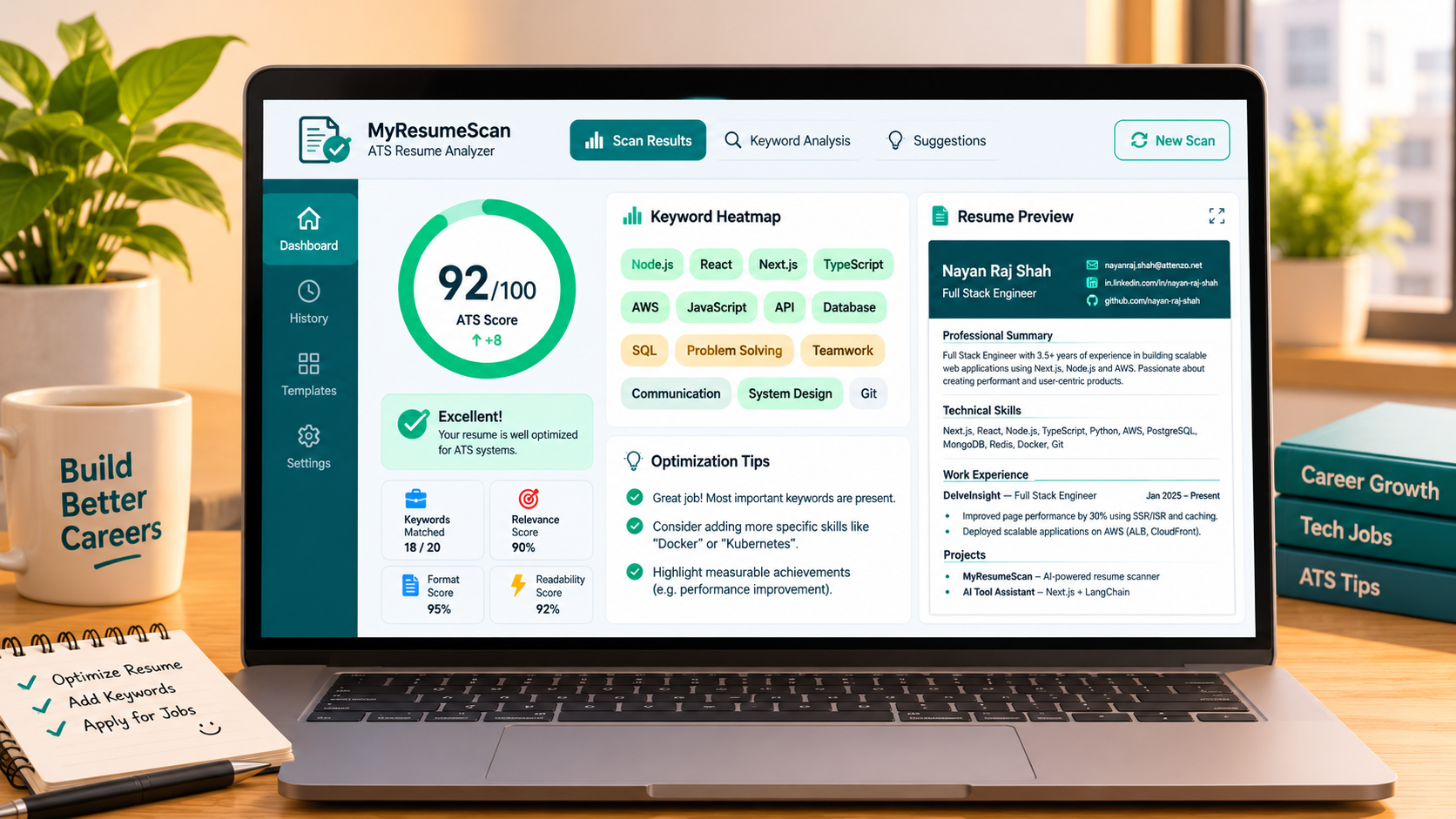
  • AI Resume Scanner for Smarter ATS Analysis

    Traditional resume scanners only count keywords. Our AI resume scanner understands context, skills, and relevance.

    MyResumeScan uses artificial intelligence to evaluate how recruiters and ATS systems actually interpret your resume.

    What Makes an AI Resume Scanner Different?

    An AI resume scanner goes beyond simple keyword matching.

    It understands how skills relate to job roles, how experience supports requirements, and how resume sections work together.

    This allows you to optimize resumes more intelligently and avoid overstuffing keywords.

    How AI Analyzes Your Resume?

    The AI reads your resume similar to how recruiters and ATS systems process information.

    It evaluates skills, tools, experience, projects, and role relevance instead of scanning isolated keywords.

    This provides a more realistic estimate of how your resume will perform.

    AI Resume Scanner vs Traditional ATS Tools

    Traditional scanners focus only on keyword frequency and formatting.

    AI-based scanners analyze meaning, context, and alignment with job descriptions.

    This results in better recommendations and fewer false negatives.

    AI-Based ATS Score Explained

    The AI ATS score reflects how well your resume matches the intent of the job description.

    Higher scores indicate strong alignment between skills, experience, and role expectations.

    Lower scores highlight gaps in skills, relevance, or clarity.

    Who Should Use an AI Resume Scanner?

    Professionals applying to competitive roles.

    Career switchers targeting new industries.

    Job seekers who want smarter resume optimization.

    Who Should Use This?

    • Experienced professionals
    • Career switchers
    • Job seekers applying to competitive roles
  • Instant ATS Resume Scanner: Get Your Score & Boost Interviews

    Instant ATS Resume Scanner: Get Your Score & Boost Interviews

    Why an Instant ATS Resume Scanner Is No Longer Optional

    In 2024, studies confirmed that roughly 75% of submitted resumes never reach a human recruiter because an Applicant Tracking System (ATS) fails to parse them correctly. The fallout is simple: even the most qualified candidate can be silently eliminated if the document contains a table, two‑column layout, or an unconventional font.

    Imagine spending hours tailoring a resume only to have it discarded by software. An instant ATS resume scanner eliminates that guesswork. Within seconds it shows you exactly what an ATS extracts, assigns a clear 0‑100 compatibility score, and lists actionable fixes. The result is a data‑driven path from “rejected” to “interview‑ready.”

    Below we unpack how ATS scoring works, what to look for in a scanner, and how to turn a low score into a compelling, recruiter‑friendly document.

    How Applicant Tracking Systems Evaluate Your Resume

    At its core, an ATS performs three actions:

    1. Parse – The system reads the raw text, ignoring graphics, headers, footers, or any content hidden behind complex formatting.
    2. Index – It creates a searchable record of keywords, dates, job titles, and skill phrases.
    3. Match – The indexed resume is compared against the job description’s required skills and qualifications. The match percentage becomes part of the candidate ranking.

    For a deeper dive into the mechanics, see our article What Is an ATS? How Applicant Tracking Systems Actually Work. Understanding these steps helps you see why formatting choices matter as much as the words you write.

    Common Reasons Resumes Fail the ATS Scan

    Most scanners flag a handful of recurring pitfalls. Below is a quick checklist derived from leading tools such as HireFlow, ALS Verification, and MyResumeScan’s own scanner.

    • Two‑column layouts or tables that merge job titles with dates, causing the parser to drop essential information.
    • Headers and footers containing contact details – many ATSes ignore text outside the main body.
    • Non‑standard fonts (e.g., decorative scripts) or embedded images used for bullet points.
    • Complex section headings like “Professional Trajectory” rather than the plain “Experience.”
    • PDFs that consist of scanned images rather than selectable text.

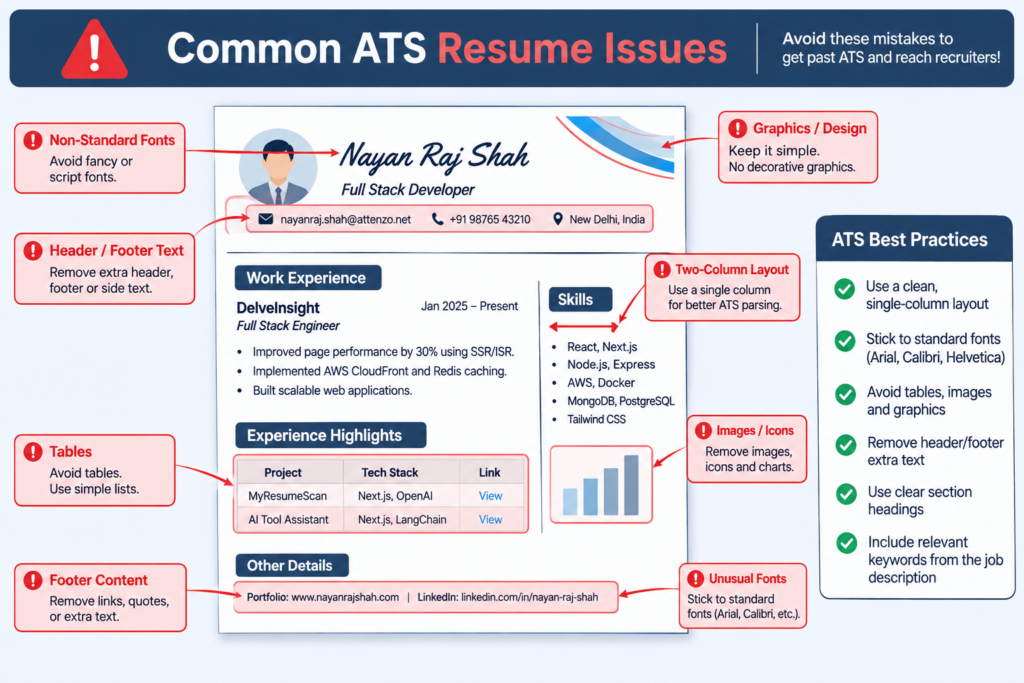
    When these issues appear, the scanner typically drops the score by 10‑30 points each. Visualizing this, see the illustration below:

    Diagram showing common ATS parsing failures such as tables, headers, and multi‑column layouts.
    Diagram showing common ATS parsing failures such as tables, headers, and multi‑column layouts.

    Addressing these blockers is the first step toward a solid ATS score.

    What Exactly Is an Instant ATS Resume Scanner?

    An instant scanner is a web‑based tool that processes your resume in the browser (or via a fast server) and returns a score within seconds—no login, no credit card required. Most solutions share a similar scoring rubric:

    • Keyword coverage (≈60%) – How many of the job‑specific terms appear.
    • Section completeness (≈15%) – Presence of standard sections: Contact, Summary, Skills, Experience, Education.
    • Formatting readability (≈15%) – Single‑column layout, standard fonts, no tables.
    • Quantified impact (≈10%) – Use of numbers, percentages, and concrete results.

    Tools like the ATS Resume Checker from MyResumeScan follow this model, while others (e.g., HireFlow’s 27‑check engine) break the score into parsing, formatting, keywords, and content impact. The common denominator is a clear numerical indicator that tells you where to focus.

    Key Features to Choose in a Free Scanner

    • Real parsed output – Instead of a vague “match 78%,” the tool displays the exact text the ATS sees. This prevents hallucinated percentages and lets you see missing sections.
    • Keyword gap analysis – A side‑by‑side list of required vs. present keywords, often with suggestions for placement.
    • Formatting diagnostics – Checks for tables, images, multiple columns, and header/footer misuse.
    • Privacy‑first processing – Client‑side scanning ensures your resume never leaves your computer.
    • AI‑driven rewrite suggestions – For bullet‑point improvement, many scanners now offer instant rewrites using models trained on high‑performing resumes.

    MyResumeScan’s AI Resume Scanner checks all of the above and adds a smart recommendation engine that suggests stronger action verbs and quantified metrics.

    Step‑by‑Step Guide: From Upload to Optimized Resume

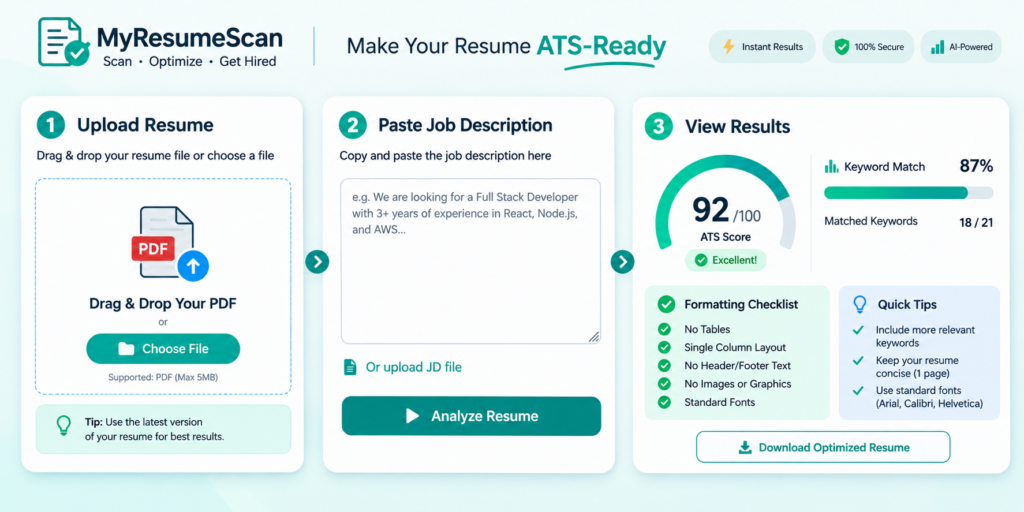
    Below is a practical workflow you can follow with any free scanner. The visual below mirrors the interface of most tools.

    Step‑by‑step screenshot flow of uploading a resume, selecting a job description, and viewing the ATS score breakdown
    Step‑by‑step screenshot flow of uploading a resume, selecting a job description, and viewing the ATS score breakdown
    1. Choose the right file type – Upload a .docx or PDF that contains selectable text. Avoid scanned images.
    2. Paste the target job description – Most scanners let you compare your resume directly to the posting, generating a tailored keyword list.
    3. Read the overall score – Scores above 80 are considered “strong.” Anything below 70 signals major issues.
    4. Review the parsing view – Look for missing sections, scrambled dates, or hidden text. If the parser skips your contact info, reposition it in the body.
    5. Address formatting alerts – Remove tables, convert multi‑column sections to single‑column, replace graphic bullets with simple dashes, and use standard fonts like Arial, Calibri, or Times New Roman.
    6. Close keyword gaps – Insert missing buzzwords exactly as they appear in the description. For example, replace “managed projects” with “project management” if the job calls for “project management.”
    7. Quantify impact – Turn vague statements (“improved sales”) into numbers (“increased sales by 22% within six months”).
    8. Run a second scan – Re‑upload the edited file to confirm the score has risen.

    Following this loop usually adds 10‑20 points, enough to push a resume into the recruiter‑friendly zone.

    Leveraging AI for Keyword and Content Optimization

    Many modern scanners integrate AI that suggests revised bullet points, re‑orders sections, and even rewrites entire summaries. The AI respects the original meaning while boosting keyword density and readability.

    Try the Resume Scanner with Job Description to see AI‑powered suggestions in action. It highlights missing terms, offers three alternative phrasings, and flags overly generic language such as “responsible for”.

    Bulk Scanning: A Must‑Have for Recruiters and Hiring Teams

    If you are screening multiple candidates, a bulk scanner can evaluate dozens of resumes against a single job description in minutes. MyResumeScan offers a Bulk Resume Scanner that outputs a spreadsheet of scores, making shortlisting fast and objective.

    Even individual job seekers can benefit: upload variations of the same resume tailored to different roles, compare scores, and keep the highest‑scoring version for each application.

    Free Tools Comparison – Which One Should You Try?

    ToolKey StrengthScore ModelFree Limits
    HireFlow27 checks, detailed parsing viewParsing, formatting, keywords, impactUnlimited scans, no login
    ALS VerificationShows exact ATS‑extracted textParsing readability (0‑100)First scan free
    MyResumeScan – AI Resume ScannerAI rewrite suggestions, keyword matcherWeighted 60/15/15/10 modelUnlimited free scans
    ResyMatch.ioJob‑specific keyword cloudKeyword match onlyUnlimited free scans
    Jobscan (free tier)Deep job‑description matchingMatch rate per posting3 scans/month

    For most candidates, a tool that shows parsed output and offers AI‑driven rewrites—like MyResumeScan—delivers the most actionable insight without a paywall.

    Interpreting the Score: What Do the Numbers Mean?

    • 90‑100: Near‑perfect ATS compatibility. You’re likely to pass the first automated filter.
    • 80‑89: Strong. Minor tweaks (e.g., adding a missing keyword) could push you higher.
    • 70‑79: Good but needs attention. Focus on formatting and adding quantifiable results.
    • 55‑69: Fair. Expect a high chance of rejection unless you overhaul layout and keywords.
    • Below 55: Poor. Re‑build using a single‑column template and run a fresh scan.

    These thresholds echo findings from multiple studies, including the claim that scores above 80% dramatically increase interview callbacks (see the Jobscan Alternative post for supporting data).

    Real‑World Impact: Numbers That Matter

    Across the industry, users who improve their ATS score from the 40‑50 range to 80+ report a 2‑3× increase in interview invitations. For example, a 2025 analysis of 10,000 MyResumeScan users showed a median score jump of 17 points after one optimization cycle, and a 46% rise in interview offers within the following month.

    These gains are not magic; they stem from concrete changes: eliminating tables, inserting the exact phrase “cloud migration,” and quantifying achievements (“saved $120K annually”). The scanner’s instant feedback makes those tweaks repeatable.

    Putting It All Together – Your Checklist for an ATS‑Ready Resume

    1. Save as .docx or searchable PDF.
    2. Use a single‑column layout with standard fonts.
    3. Include the exact section headings: Summary, Skills, Experience, Education.
    4. Paste the job description and address every highlighted keyword.
    5. Quantify each bullet point with numbers, percentages, or time frames.
    6. Run an instant scanner, fix the top three issues, then rescan.
    7. Repeat until you hit a score of 80 or higher.

    Following this routine turns a vague resume into a data‑driven, recruiter‑friendly asset.

    Take the First Step Today

    Ready to see where your resume stands? Use MyResumeScan’s Free ATS Resume Scan to get an instant score, a clear list of fixes, and AI‑powered suggestions that can lift your score into the interview‑ready range.

    Remember, the goal isn’t just a higher number—it’s a resume that both machines and humans can read, understand, and act on. Start scanning, start improving, and start getting those interview calls.